Healthcare Opioid Risk Prediction
Predictive models on de-identified healthcare claims that flag patients at elevated risk of long-term opioid therapy early enough for a provider or insurer to intervene. Built for the Humana–Mays Healthcare Analytics Case Competition.
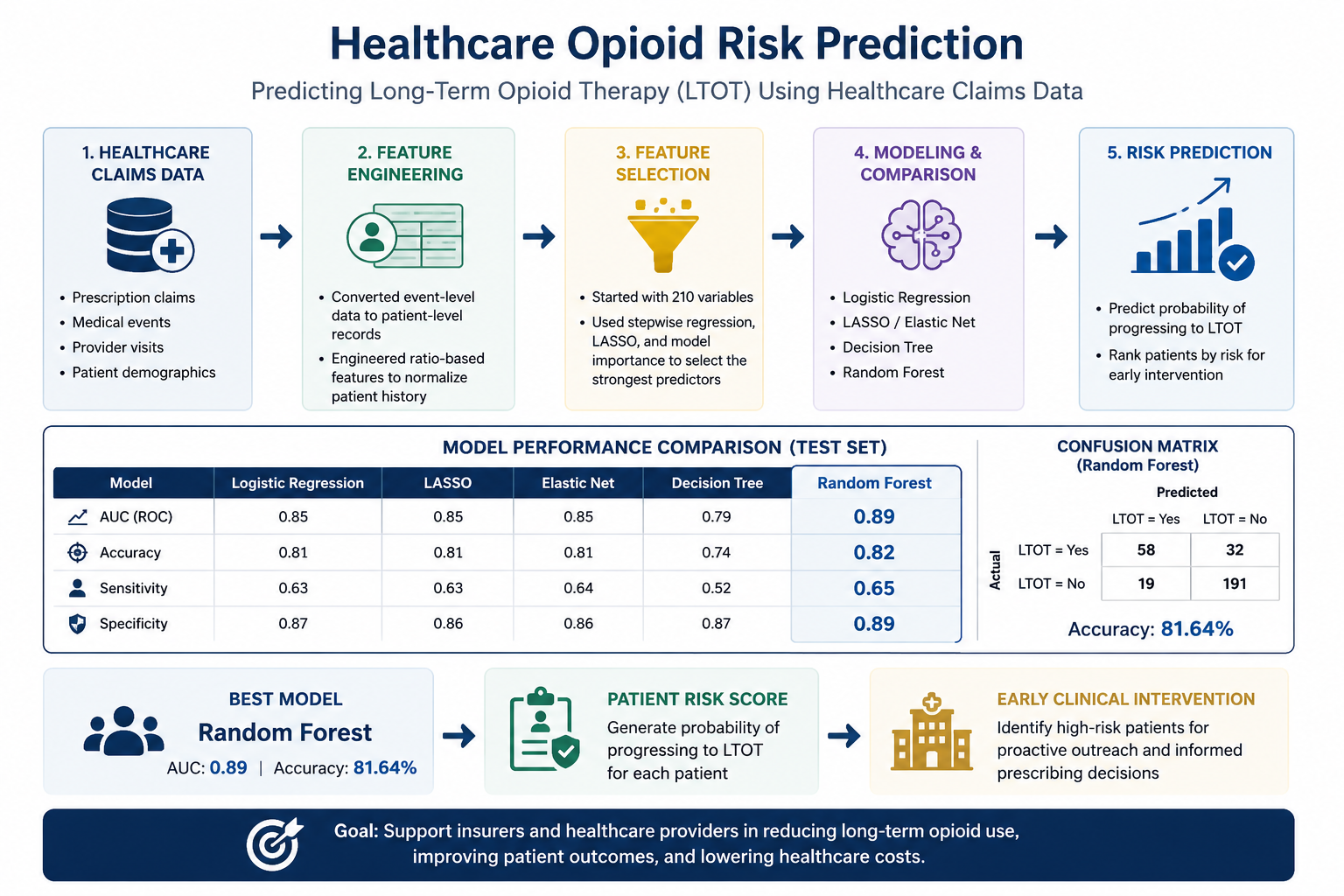
By the time opioid use is chronic, the window has closed.
Long-term opioid therapy is far easier to prevent than to reverse, but the signals that predict it are buried across prescription history, medical events, provider interactions, and utilization patterns — thousands of event-level claim records per member.
The task was to turn that history into a patient-level risk score early enough to be clinically useful, and interpretable enough to be trusted.
From claim events to a ranked risk list.
Event-level claims collapsed into one record per patient, with ratio-based variables to normalize differing history lengths.
210 engineered variables narrowed via stepwise regression, LASSO, and model-based importance.
Logistic regression, LASSO, elastic net, decision trees, and Random Forest evaluated on ROC-AUC, weighing accuracy against interpretability.
Patient-level probabilities of progressing to long-term opioid therapy, ranked for early intervention review.
A signal clinicians can act on.
In healthcare, an unexplainable model is an unusable one.
Random Forest won on performance, but the selection process weighed sensitivity, specificity, and explainability together. That trade-off framing — accuracy against adoptability — is the part I carry into every model I build now.