Personalization Engine for Content Optimization
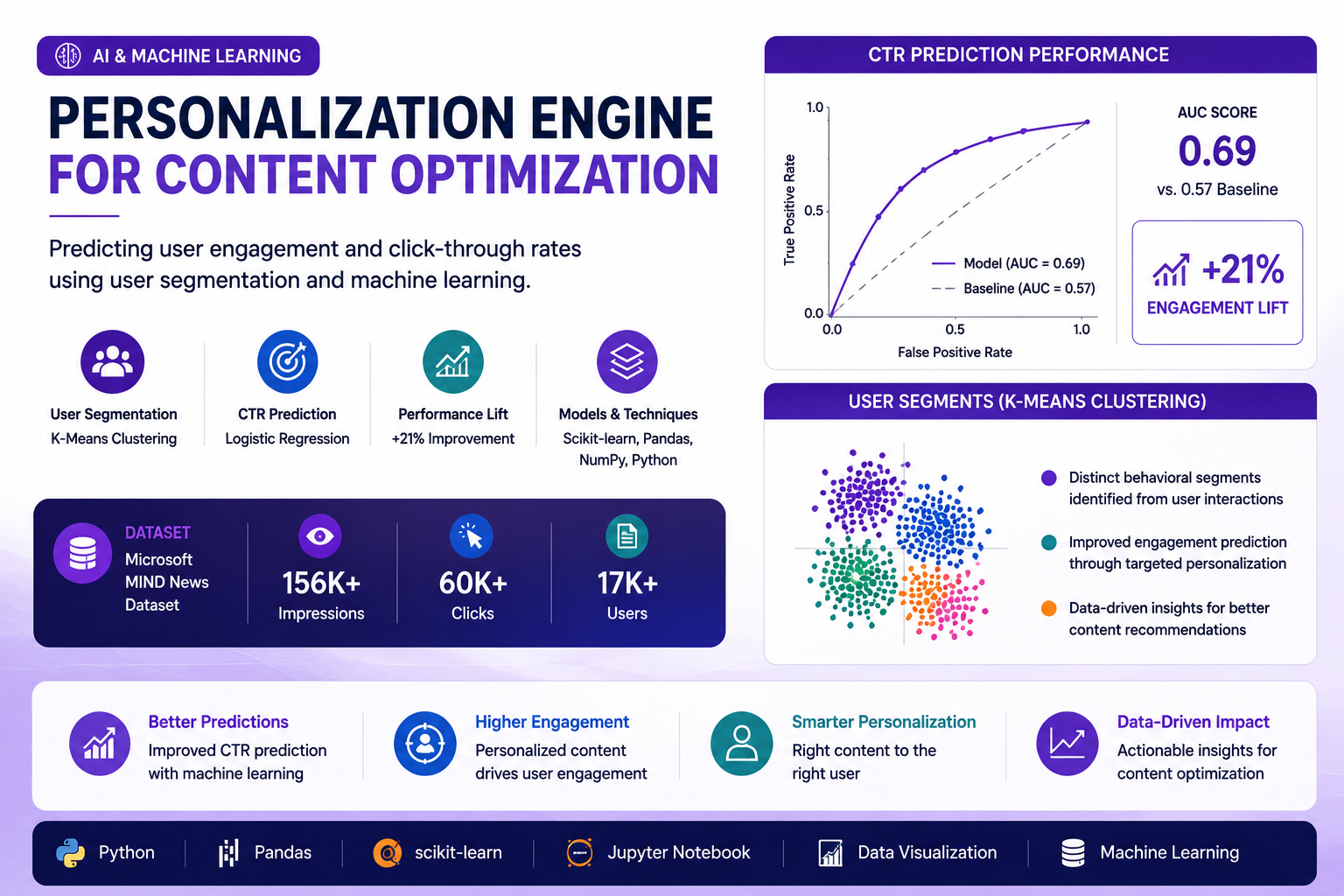
A machine learning pipeline on Microsoft's MIND news dataset that groups readers by behavior and predicts what each one will actually click — lifting click-prediction AUC from 0.57 to 0.69.
Everyone gets the same homepage.
Most content platforms recommend the same articles to every reader regardless of interest or browsing history. Engagement suffers, click-through drops, and the platform learns nothing about who it is serving.
The question I wanted to answer: how much lift comes from behavior alone, before any deep learning or real-time infrastructure?
Behavior in, click probability out.
User behavior logs, article metadata, and historical click activity merged into reader-level behavioral features.
Clustering groups readers with similar browsing patterns, giving the model a behavioral prior to work from.
A deliberately interpretable classifier estimating the probability a given reader clicks a given article.
Performance measured against a naive baseline — AUC 0.57 to 0.69, a 21% improvement.
Relevance compounds into revenue.
Simple models, honest baselines. The lift is the story.
I chose interpretable methods on purpose. A 21% AUC improvement that an editorial director can follow is worth more than a marginally better black box nobody will act on. Data source: Microsoft Research MIND, a public benchmark for news recommendation.